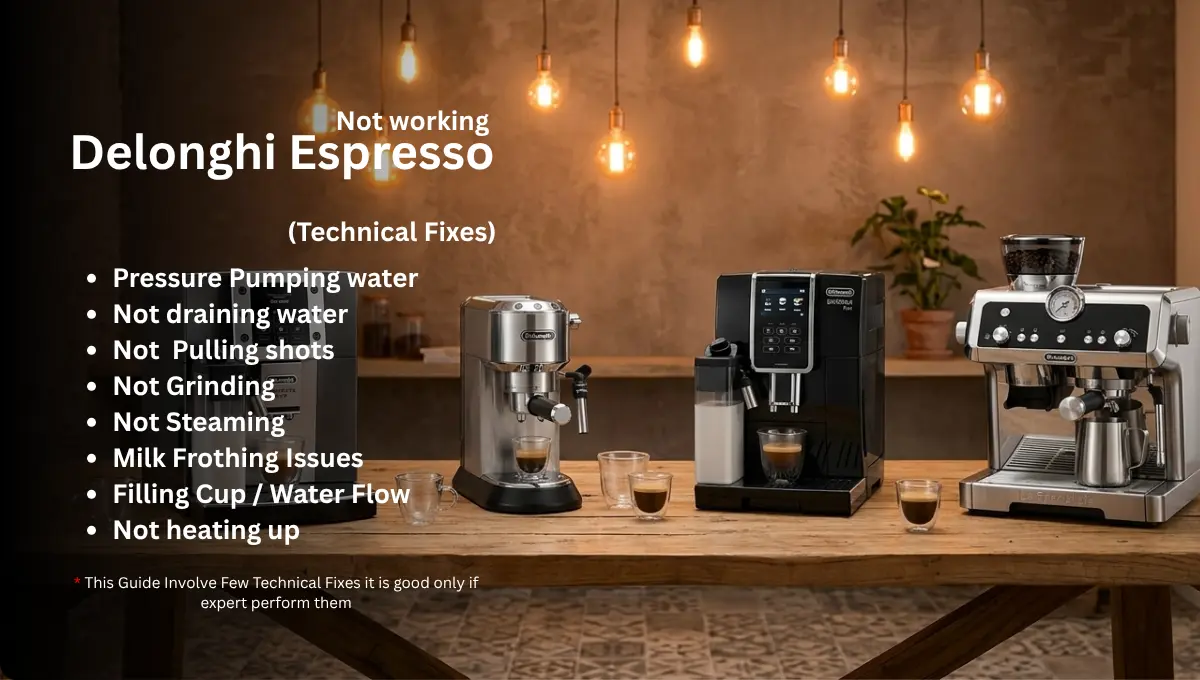
Many De’Longhi espresso machines can stop working unexpectedly, from a dead pump to no steam. These issues often strike at inconvenient times (like morning coffee). Rest assured, we’ve seen it all. We’ve gathered advice from official manuals, technician guides and repair forums to diagnose and fix every angle of dilonghi espresso problems like not heating up, not steaming, not brewing, not pulling shots, not grinding and not pumping water.
Below we cover each symptom in simple, real-world steps first (for any user), followed by deeper, tech-level solutions. Wherever possible we include expert tips for long-term reliability. This thorough guide is unique, detailed and packed with fresh insights beyond the usual tips. It even tells you how to reset your Delonghi espresso machine not working.
Important Info:
If your delonghi coffee maker not working shortly after purchase, don’t ignore it. Problems like no water flow, not heating, grinder not starting, or weak pressure are often caused by setup issues, air locks in the system, or rare manufacturing faults. Try a proper reset, check water tank placement, and run a rinse cycle. If the issue continues, use your warranty instead of attempting deep repairs at home.
In terms of lifespan, a well-maintained DeLonghi espresso machine typically lasts around 5 to 7 years for home use. With heavy daily use or poor maintenance, issues can start appearing earlier, sometimes after 2 to 3 years. Regular descaling, cleaning the brew group, and using filtered water can significantly extend its lifespan and keep performance consistent.
Machine Not Heating Up:
If your delonghi coffee machine not heating up as espresso or water stays cold, confirm you’ve waited long enough, some Delonghi models need 10-20 minutes to fully heat. Ensure the machine’s descaling light isn’t on (if so, it may block heating until reset).
Try the brew/steam cycle: do you hear the boiler or block heating up? If not, unplug/reset as described earlier. Run a rinse cycle to see if any hot water emerges. If no heat persists, no other quick user fix works, it’s likely an internal hardware issue.
Technician fixes: Many De’Longhis use a thermoblock or small boiler for heating. A primary cause of “no heat” is a blown thermal fuse or failed heating element. As one repair note explains, De’Longhi models often suffer “heating element failure and fuse blowouts causing no heat”. Technicians open the machine (power off) and locate the heating element and its fuses (often soldered onto the thermoblock’s leads).
Using a multimeter, check each fuse for continuity. Replace any blown fuse with the exact same amperage type. Inspect the heating element for damage or shorts, if it’s open-circuit, swap it. Also examine the pressurestat or high-limit thermostat (often attached to the boiler) which cuts power if overheating; a failed stat can prevent any heating.
Scale is a frequent culprit: heavy limescale on the element makes it overheat and pop the fuse. That’s why “regular descaling helps prevent overheating issues”. If the machine had run dry at some point, the element may be burned out. In summary, fix heating by replacing fuses and elements and cleaning scale: techs remove panels to reach the thermostats, fuses and heater assembly (per model’s schematic), replace faulty parts, then reassemble and test. Once repaired, the machine should again heat water and brew coffee at full temperature.
Not Pumping Water:
Internal parts of a De’Longhi-style machine, including pump (white plastic body), tubing and wiring. Checking for clogs and wear here is key to restoring water pressure.
If no water flows or the pump sounds weak, start simple. Make sure the reservoir is full and click‑locked into place. Remove it and refill if needed. Turn the machine off and back on. Run the machine “dry” (without coffee in the portafilter) to flush out stagnant water, choose the hot water or steam function to force water through the lines. This can break minor clogs.
Check for visible kinks or leaks in the intake tubing. Empty and clean the drip tray and any pre-ground coffee hoppers. If the machine has a water filter (some models do), replace or clean it. Perform a descaling cycle: as one expert notes, “If your DeLonghi isn’t pumping water, first check the pump for blockages or mineral buildup. Clean the reservoir and descale using vinegar or descaler”.
Technician fixes: Internally, De’Longhi machines use a 15-19 bar vibratory pump to pressurize water. A failing pump or a clogged inlet valve often causes no-pump issues. Open the machine’s back (always unplug first!) and inspect the pump (usually a round plastic module). Look for debris on its inlet screens or collapsed hoses.
If clogged, remove and clean the rubber valve seats and filter screens.Check the flowmeter sensor (a small turbine in the water line), scale on its plastic housing can fool the machine into thinking water isn’t flowing. In many models a thin thermistor tube and a small float or paddle detect water level; ensure the float isn’t stuck.
If cleaning doesn’t help, the pump itself may be weak or burnt out. These pumps are often replaceable (generic high-pressure pump. Faulty valves or pressure switches can prevent water from reaching the group head. Testing with a multimeter can confirm pump voltage at startup. In short, clean and descale thoroughly, then if needed replace the pump or valves, this usually restores normal water pressure and flow.
Not Pulling Shots:
If delonghi coffee machine not pulling shots (or is pouring extremely slowly), it’s often a clog or user error. Remove and rinse the filter baskets (especially pressurized baskets common on entry-level models). Make sure you’re not over-tamping or using too finely ground coffee, that can choke the brew. Try a coarser grind or lighter tamp. Run the machine without grounds (open brew cycle) to see if water flows; if so, the brew path is clear.
If water doesn’t flow, the filter basket holes or shower screen are likely blocked. Take out the portafilter, clean or replace rubber gaskets if worn, and brush out the group head and gasket area. Check if the group head’s needle or shower screen has coffee deposits (these can be poked clean with a toothpick).
Also verify settings: on programmable models, ensure cup-size limits or pump pressure settings haven’t been altered. Try resetting as above. Use filtered water to reduce mineral problems, as advised by technicians.
Internally, if delonghi coffee machine not brewing; the brewing circuit involves the pump, solenoid, and group head (with shower screen). If the machine fills the brew chamber with hot water but extracts no coffee (just water), inspect the brew group parts. The shower screen and solenoid valve often suffer scale/clog buildup.
Disassemble the brew unit: remove the group head shower and softening seals to clean them. As one repair guide points out: “check the brew group and portafilter for clogs. Clean the shower screen and ensure the coffee grounds aren’t packed too tightly. Descale the machine to remove mineral buildup affecting pump pressure”. If grounds are found behind the gasket or in the brew unit, clean the sliding brew mechanism (if present) and lubricate its tracks sparingly with food-safe lubricant.
Delonghi super-auto models (like Magnifica) also have ceramic grinders and internal brew cells, technicians may remove and clean or replace worn seals on these. A faulty pump causing low pressure will make shots weak: here a pressurestat or temperature sensor might also play a role (if boiler temperature is wrong). In that case, check the pressure relief valve (OPV), if stuck open it bleeds off pressure and coffee only drips. Adjust or replace the OPV per service manual instructions. In summary: dismantle the brew path, clean all screens and valves, descale, and if needed replace worn brew group parts (gaskets, filters) to restore normal shot-pulling.
Grinder Issues:
If the delonghi coffee machine grinder not working, first empty and refill the bean hopper, maybe it ran out of beans! Check the grind setting, if set too fine, beans may not feed properly. Listen: if the grinder motor hums or screams, it could be jammed. Remove beans and open the grinder chamber (if user-serviceable) and clear any jammed grounds or stones.
Use a small brush to remove debris from burrs. Some owners find that running the machine with no beans (on manual grind) clears stuck beans. Also ensure the machine’s grinder switch (often at the back) is turned on. If the grinder won’t start at all, try unplugging the machine and plugging it in again (resets the motor control in some models).
Technician fixes: DeLonghi super-automatic machines use a built-in burr grinder attached to the brew unit. Technicians note that if coffee tastes thin, “the grindstones may have become blunt. In DeLonghi machines, unfortunately, the entire grinder must be replaced, since the grindstones are not available as spare parts”. Thus, grinding issues often mean worn burrs or stripped gears. To fix, first open the machine (rear panel) to access the grinder assembly.
Check the gear train and motor: small plastic gears can strip, and metal shims wear out (ifixit guides mention shim washers). If the motor runs but burrs don’t spin, inspect the coupling between the motor and grind chamber. Sometimes there are metal shims between the burrs, if these drop into the grind chamber, the grinder won’t turn.
Most thorough fixes involve removing the old grinder unit and fitting a new one (available from parts suppliers or the DeLonghi shop). While in there, clear out the dose control chamber (where ground coffee falls) and the anti-blocking paddle. Ensure the grinder’s adjustment dial moves smoothly; a stuck adjustment can jam the whole thing. In short: disassemble to clean/replace the grinder, motor or gears. Replacing the burr unit is often the only option for persistent grinding failure.
Not Steaming and Milk Frothing Issue:
A barista cleaning the steam wand, a crucial daily step. Blocked or dirty steam wands are a common reason a De’Longhi frother “stops working.”
If the steam wand spits water or delonghi espresso machine steamer not working at all, check these first. Ensure the steam knob/lever is fully in the “steam” position and that the boiler has heated enough (some machines require a brief wait until ready). Always purge the wand: tap the steam dial to turn on, let steam shoot out briefly into a drip tray (clearing water condensation), then close it, this clears residual water. Wipe the wand tip with a clean cloth after every use. If frothing fails, soak or clean the tip: milk deposits can clog the tiny nozzle holes.
Unscrew (if removable) and soak the tip in hot water or use a small needle to poke clear the hole (wear gloves!). Make sure the steam dial isn’t loose or broken. Finally, try fresh, cold milk (hot/warm milk foams poorly) and a clean pitcher at least half-full. Ensure the machine’s milk frother setting (if programmable) is enabled. If no improvement, reset or unplug briefly as a last resort.
Technical fixes: Inside the machine, a steam wand is fed by a second boiler (or a thermoblock diverted hot water) and controlled by a solenoid valve. A common internal fix is replacing the solenoid valve or tee-fitting that directs boiler steam to the wand. If steam still won’t come, disassemble the group to access the steam circuit. Check that the steam valve spindle isn’t corroded or stuck; sometimes the valve knob physically disconnects from the valve when worn.
The rubber seal or O-ring on the steam valve may need replacement. On models like the Dedica, steam is generated by diverting hot water through a thermoblock. Here a temp sensor or thermal fuse (on the steam side) could fail, though that usually cuts power entirely.
Cup Filling / Water Flow Issues:
If water isn’t dispensing into the cup (from brew head or hot water tap), again check obvious points. Make sure the drip tray and cup sensor (some machines pause if no cup detected) are clear. If you hear the pump but nothing comes out, there may be an airlock: run the pump multiple times on empty to purge air. Try switching between coffee and hot water mode; one may work even if the other doesn’t. Also ensure the brew handle (portafilter) is locked in place properly, some machines refuse to pump if they think the portafilter is missing or loose.
Technical fixes: This overlaps with the pump/pouring issues above, but adds the cup-level sensor and flow sensor. Inside, a flowmeter (turbine flow sensor) often measures water; if its wires are loose or the board reading fails, it can cut off flow. Verify continuity on the flowmeter connectors.
Also inspect the cup sensor (usually a small IR or mechanical switch) under the brew head, a broken or dirty sensor may halt pouring. Another rare fault is the main PCB (with the buttons/display); an error here can wrongly block output. In-depth fixes use the service manual: check the pump relay on the control board and the water-inlet solenoid (the valve that opens to let water in).
If all else seems fine, replacing the pump (as earlier) or solenoid often restores normal water flow. Proper water flow relies on synchronized pump, valves and electronics, technicians must methodically test each with a multimeter and against the schematics for the specific De’Longhi model.
Conclusion:
Every De’Longhi has its quirks, but most common faults are solvable by diligent cleaning, descaling and basic checks (power, water). If user-level fixes fail, tracing the internal parts; pump, grinder, valves, heater, fuses and sensors, will usually locate the problem. We’ve aimed to cover every angle, including lesser-mentioned causes (like flowmeter faults, sensor errors or seal wear).
Follow the steps above in order, and you can often restore your machine without shop fees. For particularly tough cases, consult a qualified service (especially for electrical heating parts). With routine maintenance and prompt fixes, your De’Longhi espresso machine will be back to brewing great coffee reliably.