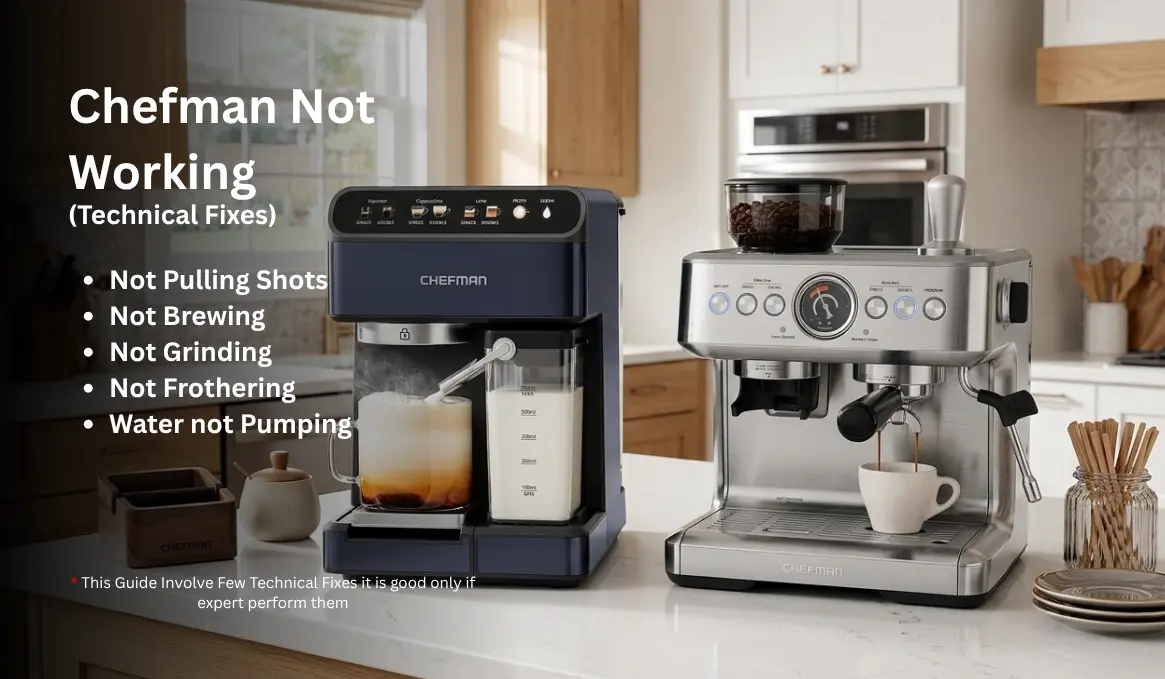
Your Chefman espresso machine is designed to deliver café-quality coffee at home, so when it suddenly stops working, it’s frustrating in a very real way. Many users experience issues where the machine stops pumping water, fails to brew, doesn’t pull proper shots, or even refuses to grind beans. These problems are especially common in models like the RJ54 series and Crema Supreme after regular use. From hands-on troubleshooting experience, most of these issues are not random, they usually come from pressure imbalance, internal blockages, or simple setup mistakes that build up over time.
This guide walks you through both real-world fixes and technician-level diagnostics for every major issue related to a Chefman espresso machine not working, so you can fix the problem properly instead of guessing.
Not Building Pressure:
If your Chefman espresso machine is failing to build pressure, the most common culprit, especially for the 6-in-1 (RJ54) and Barista Pro (RJ54-BP) models,is an internal air lock. This typically happens when the water reservoir runs dry or the machine has been sitting idle for a while, causing a bubble to get trapped in the pump. To fix this, you need to “prime” the system by filling the tank to the max line and running several “Double Espresso” cycles without the portafilter attached until water flows steadily from the group head.
If the machine is making a loud, strained buzzing noise but no water is appearing, you should also check the tiny exit hole on the bottom of your filter basket; these dual-wall baskets are prone to clogging and often require a quick poke with a thin needle or a deep soak in a descaling solution to clear out trapped oils and minerals.
For the Die-Cast (RJ54-S) or manual models, pressure issues are often caused by the “seal and grind” balance. If your coffee is ground too finely (like powdered sugar), the pump will “choke” and fail to push water through the puck. Conversely, if you notice steam or water leaking from the sides of the portafilter rather than through the spouts, the group head gasket likely has coffee grounds stuck to it, preventing a pressurized seal.
Consistently cleaning the rubber gasket and ensuring your grind consistency mimics fine table salt will help the machine maintain the resistance necessary for a proper extraction. If these manual checks don’t work, a full descaling cycle with a vinegar-water solution is recommended to clear out any internal calcium buildup that might be narrowing the boiler’s output.
Not Pumping Water:
If your Chefman espresso machine is silent or makes noise without pumping water, start with the basics. Make sure the water reservoir is filled between the “Min” and “Max” lines and properly seated. Confirm the machine is plugged in and powered on. Sometimes the issue is simply air trapped in the system, which means the machine needs priming. With water in the tank (and in the milk reservoir if your model has one), run a brew cycle with an empty portafilter. On models like the RJ54, this can help push water through the system.
You can also open the steam or hot water valve while the pump is running to release trapped air and allow the boiler to fill. Place a cup under the brew head, open the steam wand, and press the brew button, you should see water start to flow. While doing this, check for any kinks in the water lines or a blocked inlet filter, as even small debris like coffee grounds can stop water flow.
If priming doesn’t solve the problem, the issue may be internal. The pump might be running (you hear a buzzing sound) but not moving water, which can happen if it’s worn out or blocked. Mineral buildup or debris can clog the pump’s internal valves. After unplugging the machine, a technician can inspect the pump, clean the inlet screen, and check for obstructions. In some cases, replacing the pump is necessary.
It’s also worth checking other components in the water path, such as valves or the brew system, since blockages there can prevent water from reaching the group head. In certain models, faults in the heating system or sensors can trigger safety shut-offs that stop water flow. Overall, start by priming and clearing air from the system; if the issue continues, the solution usually involves cleaning, repairing, or replacing internal components like the pump or valves.
Not Pulling Shots:
If your Chefman espresso machine is making noise but producing little to no espresso, start by checking the basics around the brew setup. Make sure you’re using the correct portafilter basket (single or double) and not overfilling it. A typical double shot should use about 15-18 grams of finely ground coffee, tamped evenly with light, consistent pressure. Before locking the portafilter in place, wipe away any loose grounds from the rim to ensure a proper seal.
If the coffee flows too quickly or barely drips, the grind size or dose may be off, too coarse or too little coffee won’t build enough pressure. Try adjusting to a finer grind and slightly increasing the amount of coffee. Also confirm the portafilter is fully locked into position; if it’s loose, water can leak around the edges instead of being forced through the coffee puck. If the flow is weak or uneven, clean the portafilter, filter basket, and group head area, since built-up oils and residue can block proper extraction.
If everything on the surface looks correct but the problem continues, the issue may lie inside the machine. A clogged shower screen (the metal plate under the group head) can restrict water flow and should be removed and cleaned if necessary. The brew head gasket, which creates a seal between the portafilter and the machine, can wear out over time, if it’s damaged or loose, pressure won’t build properly.
Another possible cause is the internal solenoid valve, which controls water flow during brewing; if it’s stuck or leaking, the machine may fail to generate pressure. The pump itself could also be underperforming, if it runs but produces weak or inconsistent output, it may be partially blocked or failing.
In rare cases, electronic issues like a faulty control board or blown fuse can prevent the brew cycle from operating correctly. Overall, start by correcting grind size, dose, and portafilter fit; if the issue persists, internal components such as the shower screen, gasket, pump, or valves may need cleaning, repair, or replacement.
Not Brewing:
If your Chefman espresso machine seems completely unresponsive, no lights, no pump sound, and nothing happens when you press the brew button, start by checking its basic operating state. Many Chefman models enter a sleep mode after about 20 minutes of inactivity, where only the CLEAN indicator may remain on. To wake the machine, press the CLEAN button and wait for it to reinitialize.
Also make sure the unit is properly plugged in and that the main power switch (usually located on the side or back) is turned on. Check that the display or indicator lights respond, and confirm the water reservoir is filled and correctly positioned. Keep in mind that during normal operation, brew lights may blink while the machine is heating, so a short delay before brewing is expected.
If the machine still shows no response at all, the issue may be related to power or internal components. Start by testing the wall outlet and inspecting the power cord for any visible damage. If power is reaching the unit but it remains inactive, the problem could involve a blown fuse, a triggered thermal cut-off, or a fault in the control board.
In models like the RJ54 series, the machine should indicate when preheating is complete; if it appears stuck in a heating phase (lights blinking continuously without progress), a faulty thermostat or temperature sensor may be the cause. Some units also include safety interlocks, such as switches under the drip tray or portafilter, that prevent operation if not properly engaged. If these are misaligned, the machine may not start.
If none of these steps resolve the issue, a deeper inspection is likely needed. A technician would typically check voltage flow to key components like the pump and heating element, and examine the internal electronics for damage or failure. You can also try a simple reset by unplugging the machine for about a minute and then reconnecting it. In short, begin by ruling out sleep mode and basic power issues; if the machine still won’t respond, the cause is likely internal and may require repair or replacement of electrical components.
Not Frothering:
If your Chefman espresso machine can brew coffee but the steam wand won’t froth milk, start with a few simple checks. First, make sure the water reservoir is full, since the steam function uses the same water supply. If the tank is low or empty, the machine won’t be able to generate steam. Use cold, fresh milk for best results, warm milk or very low-fat milk doesn’t foam well. Check that the froth control (lever or dial) is set correctly, and ensure the milk container (if your model has one) is properly attached and locked in place.
The steam wand itself is a common trouble spot. Dried milk can easily clog the nozzle, reducing or completely blocking steam flow. Remove the wand tip if possible and rinse it thoroughly. You can also run the machine’s CLEAN cycle, which pushes steam or hot water through the frothing system to clear residue. After cleaning, try steaming again, you should hear the pump working and feel steady pressure from the wand.
If these basic steps don’t fix the problem, the issue may be internal. In many Chefman machines, the pump pushes water into a heating system to create steam. If the wand only releases hot water or very weak steam, the heating element or boiler system may not be reaching the proper temperature. A blocked or faulty steam valve (or solenoid) can also prevent steam from flowing correctly, sometimes due to mineral buildup. Running a descaling cycle can help clear internal passages and restore function.
Another possibility is a clogged steam nozzle that needs deeper cleaning, soaking it in warm water with a bit of vinegar can dissolve stubborn buildup. In some cases, a failed thermostat, thermal fuse, or sensor can stop the machine from heating for steam even though brewing still works. Some models also rely on safety sensors (like detecting the milk reservoir), and if those aren’t properly engaged, the steam function may not activate.
If the steam wand still doesn’t produce proper foam after cleaning, descaling, and checking setup, the problem likely involves internal components such as the heating system, valve, or sensors. At that point, professional inspection or repair is usually the most reliable solution.
Not Grinding:
If your Chefman espresso machine has a built-in grinder (such as the Crema Supreme RJ54-G-SS) and it stops grinding, begin with simple, practical checks. Avoid overfilling the bean hopper, try using a small amount of beans (around 15–18 grams) at a time. Overloading, especially with oily or dark-roast beans, can clog the grinder and stop it mid-cycle. Empty the hopper, unplug the machine, and remove it to clean the burrs thoroughly. Use a dry brush to clear out stuck grounds and buildup. You can then test the grinder by adding a small amount of beans and running it again; it should produce a steady, smooth grinding sound.
If the grinder beeps, stalls, or stops suddenly, it may be jammed. Switching to a coarser grind setting or using less oily beans can sometimes resolve the issue. In some cases, static and oil buildup cause grounds to clump—lightly misting beans with a tiny amount of water (a method known as the Ross Droplet Technique) can help reduce this and improve flow.
If cleaning and adjustments don’t fix the problem, the issue may be mechanical or electrical. With the machine unplugged, check if the grinder components feel loose or obstructed. If the motor runs but beans aren’t moving, there could be a worn or broken gear or coupling inside the grinder assembly. Also inspect the exit chute where ground coffee comes out, this area can become blocked with fine particles and stop the flow completely.
If the grinder doesn’t run at all, it may not be receiving power. Some models have safety switches that prevent operation if the hopper isn’t properly seated, so make sure everything is aligned correctly. Internally, a technician can test the grinder motor and wiring to confirm whether it’s getting power. If the motor or internal parts are worn or damaged, replacing the grinder assembly is often the most effective fix.
In short, start by reducing the bean load and cleaning the burrs to remove clogs. If the grinder still won’t work, the problem likely involves the motor, gears, or internal wiring and may require repair or replacement.
Final Thoughts:
When dealing with a Chefman espresso machine not working, the key is understanding that most problems are caused by pressure loss, airflow issues, or internal blockages rather than complete failure. Whether it’s not pumping water, not brewing, or not frothing, each issue follows a pattern that can be diagnosed step by step. Starting with simple checks and moving toward deeper inspection helps avoid unnecessary repairs and saves time.
Chefman machines are built with multiple safety systems and pressure-based components, which means even small disruptions can stop the entire process. Once you identify the root cause, the fix becomes much more straightforward. With the right approach, most of these problems can be resolved without replacing the machine, restoring it back to full performance.