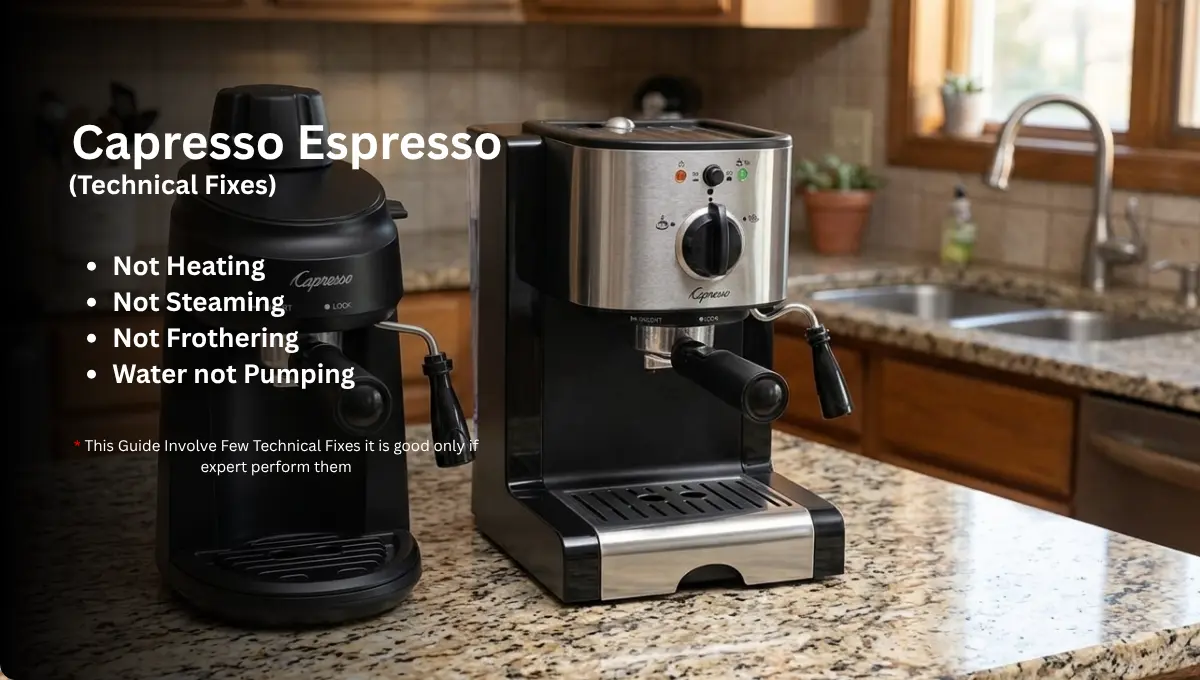
If your morning starts with pressing the brew button and nothing happens, you’re not alone. Many owners notice their capresso espresso machine not working suddenly after months of normal use. Sometimes the machine turns on but doesn’t brew. Other times the water stays cold, the pump sounds weak, or the milk frother stops responding. These problems are common in models like the Capresso EC100, Ultima Pro 124, Café Pro, and Steam PRO 303.
The good news is most issues are not permanent failures. In many cases, the machine is reacting to blocked passages, temperature timing mistakes, or small internal parts that need attention. This guide explains exactly what real users can check at home and what a trained technician would inspect inside the machine when a capresso espresso machine not brewing, pumping water, or steaming correctly.
Not Hot Enough:
If your espresso tastes weak or only warm, start by checking the machine’s warm-up routine. Capresso machines use thermoblock heating systems that need a full heat cycle before brewing.
Turn the machine on and wait until the ready indicator stays steady. Run one empty brew cycle without coffee first. This warms the group head and portafilter. Also rinse the filter basket because coffee oils trap heat and affect extraction temperature.
A technician would inspect the thermoblock heater, temperature sensor, and safety thermostat inside models like the Capresso EC100 and Ultima Pro 124. When scale builds inside the thermoblock chamber, water passes too quickly and never reaches proper brewing temperature. Internal testing usually includes checking continuity of the heating element, inspecting the thermal fuse near the heater body, and verifying the control board relay that activates heating cycles during espresso mode.
Not Brewing:
When a capresso espresso machine not brewing, the first step is checking the water tank seating position. The tank valve must press down fully into the intake port. If it sits slightly raised, the pump cannot draw water. Remove the portafilter and run a brew cycle without coffee to see if water flows. Also clean the filter basket because very fine coffee grounds can block pressure flow inside seconds.
From a technician’s perspective, models like the Capresso Café Pro and Ultima Pro rely on a vibration pump connected to a pressure-controlled brew valve. If the pump hums but nothing flows, the inlet hose may contain trapped air.
Internal inspection includes checking the pump chamber diaphragm, brew solenoid valve alignment, and pressure switch calibration. Sometimes the issue is simply a worn pump seal that prevents pressure from reaching the group head.
Not Pumping Water:
If your capresso espresso machine not pumping water, start by removing the water tank and pressing the small rubber valve underneath. It should move freely and spring back instantly. If it sticks, rinse it under warm water and reinstall the tank carefully. Try running a brew cycle again without coffee to prime the pump. Many machines recover immediately after this simple step.
Technicians usually open the pump housing when water still does not move. Inside machines like the Steam PRO 303 and EC100, the vibration pump contains a small internal piston that can stick after mineral buildup. The intake tube may also develop micro-air leaks that stop suction completely.
Repair involves resealing tubing joints, cleaning scale from the pump chamber, or replacing the pump assembly if pressure output drops below brewing range.
Steamer Not Working:
A capresso espresso machine steamer not working often happens because the machine switches temperature modes between brew and steam. After brewing espresso, rotate the selector knob fully to steam mode and wait for the steam indicator before opening the steam valve. Also remove the steam tip and rinse it because dried milk blocks airflow faster than most users expect.
Internally, technicians inspect the steam valve assembly used in machines like the Capresso Ultima Pro and Steam PRO 304. The steam path runs directly from the thermoblock chamber through a narrow metal tube. Scale buildup inside that tube reduces pressure dramatically.
Repair usually involves cleaning the steam valve seat, replacing worn O-rings, and checking the thermostat responsible for switching the heater into steam temperature mode.
Milk Frother Not Working:
If your capresso espresso machine milk frother not working, first clean the frothing attachment completely. Remove the frothing sleeve and soak it in warm water. Milk residue hardens inside the air intake hole and prevents foam from forming even when steam pressure is normal. Also confirm the machine has reached steam temperature before inserting the wand into milk.
Technicians working on Capresso frothing systems usually inspect the air-mixing chamber attached to the wand assembly.
In models like the Café Pro Espresso and Cappuccino Machine, the frother depends on correct airflow entering the mixing nozzle. If the nozzle seal loosens or becomes blocked internally, milk cannot aerate properly. Repair includes replacing the frothing sleeve gasket or restoring airflow through the venturi channel inside the wand connector.
Maintenance Steps That Prevent Future Problems:
Simple maintenance keeps machines like the Capresso EC100, Ultima Pro, and Steam PRO series working reliably for years. Always rinse the portafilter after each use so coffee oils do not harden inside the filter basket. Run a blank brew cycle weekly to flush internal passages and keep pressure flow consistent.
Descaling every two to three months is especially important if your machine begins showing signs of a capresso espresso machine not pumping water or weak steam output.
Mineral buildup forms inside the thermoblock heating channel first, then spreads toward valves and tubing. Regular cleaning protects both heating performance and pump lifespan.
When a Capresso Machine Needs Professional Repair:
If your capresso espresso machine not brewing even after cleaning the filter basket, priming the pump, and descaling the system, the issue may involve internal electronics or pressure components. Symptoms like silent pumps, blinking ready lights, or repeated shutdown cycles usually indicate a thermostat or control board problem.
At this stage, a technician normally tests voltage delivery to the vibration pump, checks heater resistance values, and inspects the brew selector switch contacts.
Machines such as the Ultima Pro 124 include internal safety cutoffs that stop brewing if pressure rises outside safe limits. Repairing these components restores full espresso performance safely and reliably.
| Service Name | Region | Best For | Contact Method |
|---|---|---|---|
| Stefano’s Espresso Care | USA | Pump issues, thermoblock failure, internal repairs | Ship-in service scheduling |
| More Than Vacuums Repair Service | USA | Not brewing, not pumping water, steam wand problems | Local drop-off / request |
| JURA Authorized Service Network | Europe | Advanced faults, OEM parts replacement, full diagnostics | Authorized service centers |
Conlcusion:
With the right troubleshooting steps, most cases of a capresso espresso machine steamer not working, brewing failure, or temperature problems can be solved at home without replacing the machine. Careful cleaning, proper warm-up timing, and occasional descaling keep Capresso espresso systems performing the way they were designed to work.