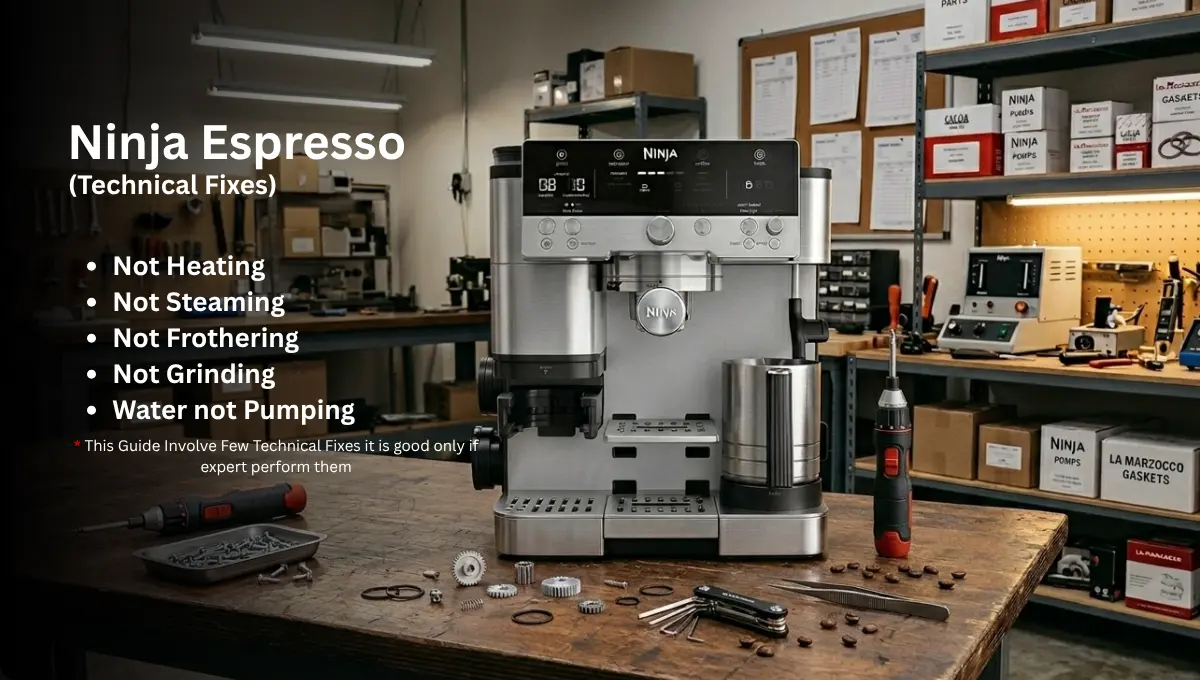
If your Ninja espresso machine not working suddenly stopped making coffee the way it should, you are not alone. Many users notice problems like the machine not turning on, not brewing properly, not pulling shots, not grinding beans, or not frothering milk after a few months of use.
These issues usually happen because of internal protection systems, blocked water lines, grinder jams, or heating element behavior that most people don’t know about.
As someone who works with home espresso systems regularly, I’ve seen these exact problems across models like the Ninja Luxe Café ES601, Ninja DualBrew Pro CFP307, Ninja Specialty CM401, and Ninja Barista System CFN601. The good news is that most issues can be diagnosed quickly if you follow the right troubleshooting order. This guide walks you through each problem step-by-step like a technician would.
Not Turning On:
If your ninja espresso machine not turning on, first check the basics before assuming something serious is wrong. Try plugging the machine into another outlet because kitchen sockets often trip quietly. Remove and reinstall the water reservoir fully since some Ninja machines will not start if the tank sensor is not aligned correctly.
Also check if the brew basket or pod adapter is locked properly because safety switches inside the lid can stop startup.
From a technician perspective, power failure inside models like the Ninja CM401 or CFP307 often relates to a thermal cutoff fuse near the heater assembly or the main control board relay. These parts protect the machine during overheating or voltage spikes.
Opening the lower housing usually reveals whether the inline fuse or power switch wiring has failed. In some ES701 units, a loose connector between the control panel and power board is the real cause of startup failure.
Not Hot Enough:
If your Ninja espresso machine not hot enough during brewing, start by running one empty brew cycle without coffee. This warms the internal tubes before your real shot starts.
Also make sure the machine is not in an eco or specialty brew mode that lowers temperature slightly. Descaling the machine can also improve heating performance because mineral buildup blocks heat transfer inside the water path.
Technicians usually find that temperature issues come from heating coil scaling or thermistor misreading. In Ninja DualBrew CFP301 and CFN601 machines, the thermistor controls brew temperature precisely.
If this sensor reads incorrectly, the machine stops heating early. Another common cause is a partially weakened heating element that still works but cannot reach full espresso extraction temperature, which explains weak or lukewarm shots.
Not Brewing:
If your ninja espresso machine not brewing or not starting the brew cycle, first confirm the drip stop switch is open and water is flowing from the reservoir valve.
Many users do not realize the reservoir has a release valve underneath that must sit correctly inside the base. Cleaning the brew basket and pod needle area also helps restore flow when the machine refuses to start brewing.
Internally, brewing failure usually points toward pump restriction or air trapped inside the water line. Machines like the Ninja Barista CFN601 sometimes develop small air pockets after refilling the tank.
Running two rinse cycles normally clears this. If not, the internal pressure pump may be losing strength or the intake mesh filter inside the reservoir port could be blocked, preventing the system from pulling water correctly.
Not Pulling Shots:
When users say their ninja espresso machine not pulling shots, they usually mean espresso extraction starts but stops early or produces weak flow. Begin by checking grind size if using fresh beans.
Too fine grinding blocks pressure flow. Also confirm the portafilter or pod adapter is fully locked into position because partial locking reduces pressure inside the brew chamber.
Technician inspection often shows the pressure valve or flow meter controlling shot timing is responsible. In Ninja ES601 and ES701 machines, shot timing depends on pressure feedback from internal sensors. If scale builds up near the valve assembly, extraction stops early. Cleaning the brew head screen and running a deep descale cycle usually restores proper espresso pressure behavior.
Not Grinding:
If your Ninja espresso machine not grinding beans, empty the hopper and check for oily beans stuck between the burr teeth. Oily beans commonly create compact layers that stop grinder rotation. Cleaning the burr chamber using the cleaning brush included with your machine often restores movement immediately.
From a technician standpoint, grinder failure inside models like the Ninja Luxe Café ES601 normally involves either a jammed burr carrier or worn drive gear coupling.
The grinder motor itself rarely fails first. Instead, compacted grounds block the lower exit chute. Removing the upper burr assembly and clearing the chute usually solves this without replacing parts.
Not Frothering:
If your Ninja espresso machine not frothering milk properly, remove the frother attachment and rinse it carefully with warm water. Milk residue dries quickly and blocks the whisk rotation area. Also confirm the frother arm clicks fully back into position because some models stop operation when alignment sensors are not triggered.
Technicians often discover that frother heating coils weaken after repeated dry operation without milk. Models like the Ninja CM401 and CFP307 include automatic frother heaters that rely on temperature feedback circuits.
When these sensors detect overheating conditions earlier than expected, the system disables frothing to prevent damage. Resetting the machine and cleaning the frother base usually restores operation unless the coil itself needs replacement.
Prevent Future Ninja Espresso Machine Problems:
Most users experience repeated issues because they skip maintenance steps that protect internal components. Running a descale cycle every 4 to 6 weeks keeps the heater working correctly and protects the pressure pump from restriction. Cleaning grinder burrs monthly prevents motor strain that eventually stops grinding completely.
Another important habit is drying the frother after every use and refilling the water tank before it runs empty. Running the machine dry allows air inside the pump system, which leads to brewing problems later.
These small habits extend the life of Ninja espresso machines like the CFN601, ES701, and CM401 significantly. If you won’t be able to find the cause of issue or did not able to fix the problem then contact Ninja espresso repair service providers
| Service Provider | Country | Best For |
|---|---|---|
| Expert Appliance USA | USA | Electrical faults, power failure issues, heating problems, and pump replacement diagnostics |
| Express Repair USA | USA | Grinder failures, control board issues, brewing system repairs, and maintenance servicing |
| The Coffee Repair Clinic | UK | Pressure problems, shot extraction faults, heating element service, and full diagnostics |
Conclusion:
If your ninja espresso machine not working even after trying these steps, listen carefully to what the machine does when starting. No sound usually means a power issue.
Clicking without brewing usually means pump restriction. Grinding noise without coffee flow usually means pressure blockage. These sound patterns help identify the problem faster than random testing.
Following this structured approach solves most cases of ninja espresso machine not turning on, ninja espresso machine not brewing, ninja espresso machine not pulling shots, Ninja espresso machine not grinding, Ninja espresso machine not frothering, and Ninja espresso machine not hot enough without needing replacement parts.