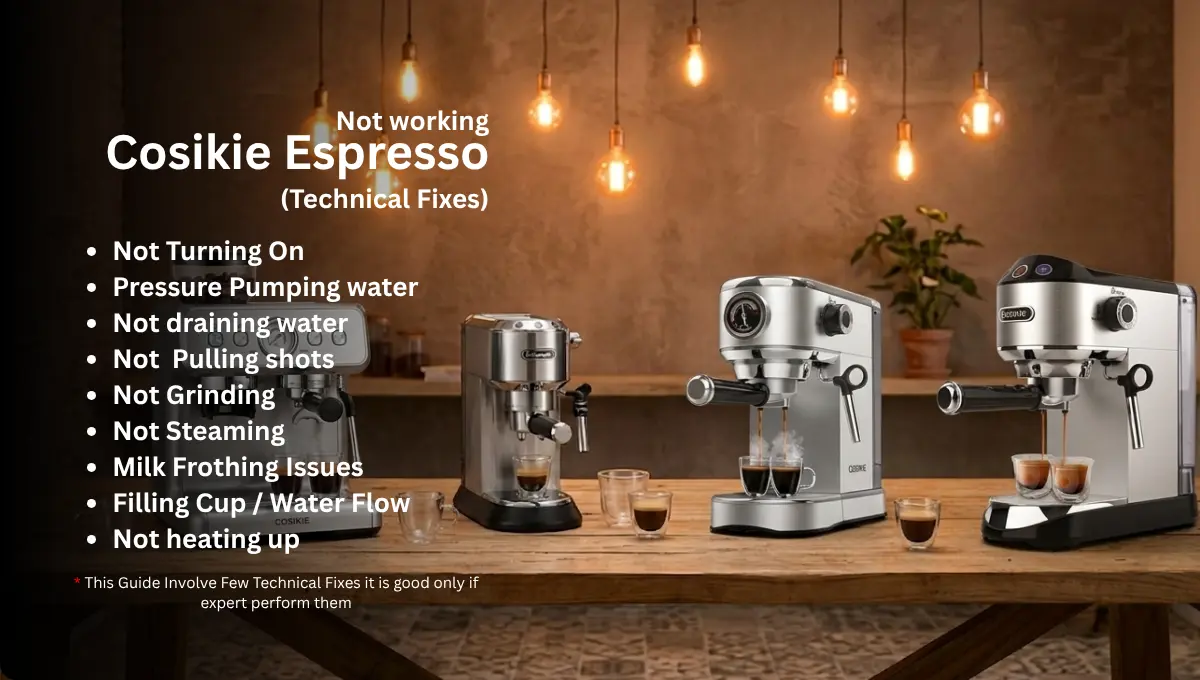
If your Cosikie espresso machine not working, you’re not alone. This is one of the most common problems home coffee users face, especially after a few months of daily use. One day everything works fine, and the next day the machine won’t turn on, doesn’t heat, or stops pouring coffee properly.
From my experience working with semi-automatic espresso machines like Cosikie, most issues are not as serious as they seem. In fact, around 70% of problems come from simple things like water flow blockage, sensor misalignment, or minor electrical faults. The remaining issues involve internal components like the pump, heating system, or control board.
This guide will walk you through real, practical fixes, starting from simple checks you can do at home, all the way to technician-level repairs that explain exactly what’s happening inside your Cosikie machine.
Lifespan Vs. Usage:
If your Cosikie espresso machine not working shortly after purchase, don’t ignore it. Whether you’re using models like the Cosikie CM6863, CM6821, or CM6850, issues such as no water flow, inconsistent heating, grinder not starting, or weak pressure are often caused by setup mistakes, trapped air in the system, or occasional factory defects. Start with a proper reset, check that the water tank is correctly placed, and run a rinse cycle. If the problem continues, it’s best to use your warranty instead of attempting complex repairs at home.
In terms of lifespan, a well-maintained Cosikie espresso machine typically lasts around 4 to 6 years for home use. With heavy daily usage or poor maintenance, issues can begin much earlier, sometimes within 1.5 to 2 years. Regular descaling, cleaning internal parts, and using filtered water can help extend its life and keep performance consistent.
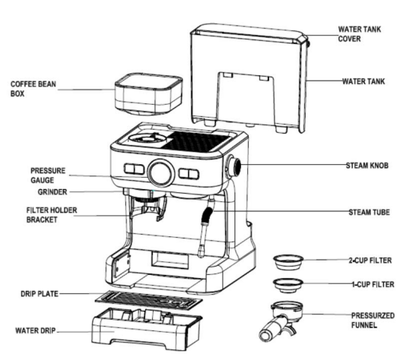
Cosikie Espresso Machine (Parts)
Before Reading fixes it is important to know about internal part of espresso machine.
- Water Tank with float sensor
- Vibration Pump (15-20 bar)
- Thermoblock / Boiler Heating System
- Control Board (PCB)
- Grinder Unit with safety switch
- Solenoid Valve & Pressure Relief System
- Steam Wand & Valve
Understanding these parts will help you fix problems faster.
1. Not Turning On:
Start by checking the simplest things. Make sure the machine is plugged into a working outlet. Try another socket to confirm. Press the power button firmly, Cosikie machines sometimes require a solid press to activate. Also check if the water tank is properly seated. Many users don’t realize that if the tank isn’t aligned correctly, the machine won’t start at all.
Look for any loose cable or damaged plug. If there are no lights or sounds, unplug the machine for 5 minutes and try again to reset it.
If the machine is completely dead, the issue is usually inside the power circuit. Cosikie machines commonly have a thermal fuse attached to the thermoblock, which shuts off power if overheating occurs. A technician will open the base, locate the fuse near the heating unit, and test it with a multimeter.
If it’s blown, replacing it restores power. Another common failure is the power switch or PCB solder joints, especially in budget models. Loose connections or burnt traces can stop current flow. Re-soldering or replacing the switch usually fixes the issue.
2. Not Heating Up:
If the Cosikie powers on but stays cold, start with simple checks. First, verify that the steam knob is turned off and you have pressed a brew or hot-water button; some machines won’t heat unless they think you’re brewing. Try running water through the hot-water spout: place a cup under the nozzle and press the hot-water button.
If this still yields cold water or nothing, turn off and unplug the machine, let it sit for 5 minutes, then plug in again (resetting any thermal cutouts). Also inspect the water tank for mineral deposits, heavy scale can clog the thermoblock. If you’ve never descaled the machine, do so with a coffee-machine descaler (this can remove buildup inside heating passages).
Finally, allow the machine a full 10 minutes after powering on; the Cosikie’s 15-bar boiler takes a minute or two to reach steaming temperature. If after these steps it still doesn’t heat, move on to the technician fixes below.
In-depth, a technician will check the heater and thermostat. After unplugging the unit, they’ll remove the side or bottom panel. They will locate the heating element or thermoblock (usually on or near the boiler) and test it for continuity. A normal reading is a few ohms; if it’s infinite (open circuit), the element has failed and must be replaced with an exact OEM part. They’ll also check the high-limit thermal fuse (often a small cylinder or disc on the boiler housing).
If this fuse shows no continuity, it means it blew out (often due to dry-boil or overheating) and must be swapped. Next, the thermostat or thermistor sensor is examined, if it’s damaged or disconnected, the machine may refuse to heat. The technician might also verify the control board power supply: on some Cosikies, a burnt MOSFET or relay stops current flow to the heater. Replacing any bad relay or repairing PCB traces can restore heating. These detailed steps get the machine truly hot again, beyond what a simple descaling can fix.
3. Pump Leaking or Continuously Pumping Water
If your Cosikie is pumping water nonstop or leaking from the base, begin with the easy stuff. First, empty the drip tray: Cosikie manuals warn that an overfilled drip tray can cause leaks from the bottom. Also remove and clean the small drip tray well or cup; it has a float so if it’s jammed up with grounds, the machine may think it’s full and spit water out. Next, check that the brew portafilter (handle) is properly installed.
Some models won’t pump if the portafilter isn’t secured, and others will run water if the brew switch is held. Try brewing with the handle removed (just press a brew button). If water drips non-stop, you may have accidentally held a brew mode on, just turn off the brew/steam valves or switch to standby. Also inspect the backflow hose from the pump to the tank (if visible): if it’s dislodged, the pump will loop water back to the tank continuously. Secure it back in place if needed. These simple checks often stop unwanted pumping or leaks.
For a tech-level fix, the pump and valves come into play. Cosikie machines use a 20-bar Italian pump, which has a non-return (check) valve to prime the brew cycle. If the pump is running but not pushing water forward, the check valve may be stuck or broken. A technician will remove the pump (after unplugging and emptying water) and inspect or replace the check valve in its outlet.
They’ll also inspect the silicone tubes for cracks or blockages. Another culprit is the brew solenoid or pressure relief valve: if stuck open, it will leak water into the drip tray during brewing. On some Cosikie machines a three-way valve diverts pressure to the tray when the brew button is released; if this valve fails, water leaks. The tech will test the valve coil or plunger and clean or replace it.
Tightening any loose fittings and replacing o-rings on the pump or boiler can also stop hidden leaks. These fixes go beyond the user’s reach but are common repairs that keep the water only going where it should.
4. Pulling Shots / Brewing Issues:
If coffee isn’t flowing properly, start with brew-head maintenance. Remove the portafilter, take out the filter basket, and rinse everything under hot water. Wipe the group gasket and shower screen (the metal disc under the brew head), old grounds can block flow. Reinstall and lock the portafilter firmly (a loose seal leaks steam and reduces pressure). Make sure you’re using the right filter basket (single vs double) and that it’s not damaged.
Use freshly tamped coffee ground to the proper level (about 13-15g for single, 20-22g for double) and ensure it’s not too coarse or too fine, very fine grind can stop flow. Also try purging the head: with the portafilter out, press the 1‑cup button for a second to flush water through the group head, then insert the portafilter and brew again. This clears air and stabilizes temperature. If shots are still weak or watery, use the pressure gauge: Cosikie’s pump can push up to 20 bar but ideal brewing is around 9-12 bar. If the gauge needle stays low (<5 bar), the grind is too coarse or the dosage too small, adjust those and try again.
A technician will delve into internal brew-system parts. They will inspect the group head gasket and screen assembly: worn rubber gaskets or clogged screens can cripple pressure. Removing scale from the shower screen is key, a hardened deposit inside can block flow (soaking it in vinegar or replacing it fixes many brew issues).
They’ll also test the brew button/switch and control board: if the switch is intermittent, the pump may cut out mid-shot. Another advanced fix is examining the pressure gauge tubing: sometimes the gauge port can leak if the tube cracks. The pump itself can be tested at its outlet with a pressure gauge attached; if it fails to build proper pressure, the pump or its seals may be worn. Technicians may also recalibrate the brew-relief valve inside (if present) to ensure correct back-pressure. In short, internal maintenance of gaskets, valves, and pump seals often restores strong espresso flow.
5. Grinder Not Working:
Many Cosikies have a built‑in grinder that only runs when a portafilter is in place. If you press “grind” but nothing happens, first check this safety interlock. Insert the portafilter into its bracket and push gently; you should feel a small click as a switch is engaged, then the grinder motor will start (and stops when you release it). If you’ve been trying to grind with the handle out, that explains the silence.
Also ensure there are beans in the hopper and the grind setting isn’t on ultra-coarse, some motors stall if beans won’t feed. If it still won’t grind, unplug the machine, open the lid, and visually check for jammed beans in the chute. Remove any large stuck bits. Then try again. If the grinder struggles and seems slow or stops even with beans, it could mean the blades/burrs are clogged with dust or oily residue. Running the grinder briefly with no beans (and letting the ejected dust blow out) can sometimes clear a minor jam.
For a detailed fix, a technician will service the grinder unit. They’ll first remove the hopper and filter bracket. The grinder assembly can often be lifted or unscrewed. Inside, the tech will clean out all residues: dried grounds, oil, or tiny stone fragments (some coffees have small stones that chip burrs). They’ll inspect the burrs (or blades) for wear, dull burrs grind poorly and need replacement.
They’ll also test the small grind-activation switch under the brew arm, sometimes the pin that presses it breaks or misaligns. If the switch is bad, they replace it or bypass it (though bypass is not recommended for safety). The motor itself can be tested for power and replaced if burnt out (though motor failure is rare). Proper reassembly includes lubricating any moving shafts and ensuring the release button mechanism (some Cosikies have a quick-release lever) is functional. After this overhaul, the grinder should work as intended.
6. Steam / Milk Frothing Issues:
If the steam wand won’t foam milk, start by purging and cleaning. Turn on the steam function (machine must be fully heated first), then run a blast of steam into the drip tray for a few seconds to clear condensate. Then submerge the wand tip just below cold milk’s surface and gently turn the steam knob. Move the pitcher so the tip stays near the surface, this creates whirlpool agitation and helps foam. Use only fresh, cold milk (non-fat milk resists foaming).
Do not use an oversized pitcher; manual says an overly large container can prevent frothing. If steaming still fails (just dribbling or no steam), check that the steam knob is actually opened fully. On Cosikie machines, the steam/vapor valve must be turned to the steam position with enough torque. A loose or jammed valve handle can block steam flow. Also inspect the small steam tip: it has a fine hole that clogs with dried milk easily. If you see crusty milk there, unscrew the tip and soak it in vinegar solution before attempting again.
At the component level, a technician will check the steam assembly. They might remove the wand from the boiler and clean out any blockages inside the tube. The steam valve (often a plastic or metal knob assembly) contains rubber seals that degrade; replacing these seals or the entire valve can restore full steam pressure. They will also test if the boiler is reaching steam pressure: a failing thermostat or thermistor can erroneously limit steam output.
The boiler’s heating element draws extra power when steaming, so the tech will check that the heater still glows red-hot, if not, the element or its control circuit may be at fault. Finally, if the gauge and controls indicate steam mode but only water drips out, the boiler’s internal safety valve might have slipped. A tech can replace the boiler’s safety or adjust the pressure stat if it’s opened at too low a pressure. With proper cleaning and parts replacement, a full, powerful steam output is restored.
7. Filling Cup / Water Flow Issues:
If cups aren’t filling or water flows too slowly, ensure the basics: is the machine actually in brew mode? Press the 1-cup or 2-cup button firmly once power is on. Some Cosikies require holding the button for a moment to engage the pump. Listen for the pump priming noise, a loud buzz means it’s working. If you hear nothing, unplug and replug the machine (resetting any overload protection).
Check the water tank again: if its float is stuck or if there’s no water, the pump can run dry. Also confirm the tank’s vent (at the cap or lid) is not blocked by debris, if air can’t enter as water leaves, flow will stop. If your model has a small water filter in the tank, ensure it’s clean (some Cosikies include a reusable mesh filter at the tank intake). Finally, try descaling: limescale can clog the flowmeter or brew-head channels. Run a half-strength citric acid or vinegar solution through brew cycles (with no coffee) to clear scale. If flow improves after this, scale was likely the culprit.
From a technician’s view, they’ll inspect internal flow parts. After removing panels, they’ll trace the tubing from the tank to the pump to the group head. Any kinked or collapsed tube can be replaced. The pump itself can be bench-tested: disconnect it and fill with water manually to see if it can push out 1-2 liters per minute (typical for 20-bar pumps at zero head). If flow is weak, the pump may have lost prime or lost efficiency and might need rebuild or replacement.
Next, if your Cosikie has a brew water solenoid or coil (some semi-automatics do), they’ll test its function; a stuck-open solenoid will leak water, while a stuck-closed one will stop brew. Finally, they’ll check the small brew gauge tube (from gauge to machine), even an air bubble there can mislead diagnostics. Correcting or replacing any failed valve, tube or pump ensures normal water flow to your cup.
Conclusion:
A Cosikie espresso machine not working can feel frustrating, especially when you rely on it daily, but in most cases, the problem is fixable with the right approach. From simple issues like a poorly seated water tank or clogged steam tip to more technical faults inside the pump, thermoblock, or control board, every problem has a clear cause once you understand how the machine works. The key is to start with basic checks, stay consistent with cleaning and descaling, and only move to internal repairs when necessary.
If handled properly, even a machine that seems completely unresponsive can often be brought back to full performance. With regular maintenance and early troubleshooting, your Cosikie machine can continue delivering reliable espresso for years without major breakdowns.