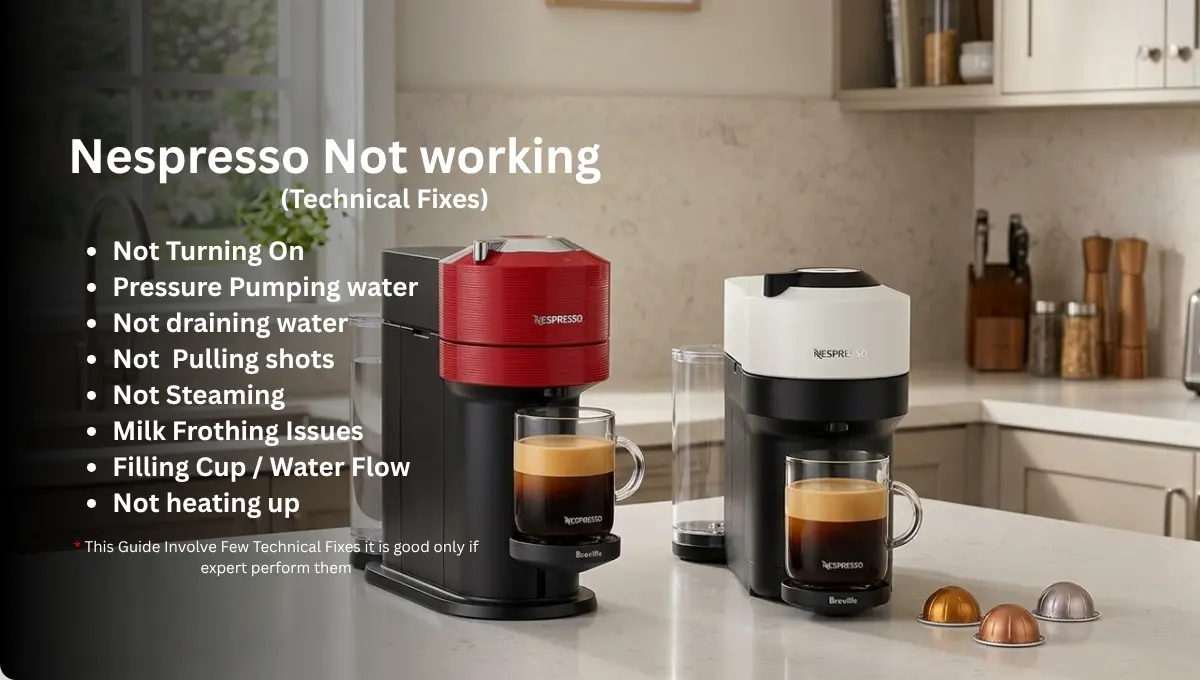
I know how frustrating it feels when you rely on your machine every morning, press the button, and suddenly your Nespresso not working the way it should. I’ve dealt with this issue many times, and in most cases, the problem turns out to be something simple like a loose water tank, scale buildup, or a quick reset that was needed. But there are also situations where the issue goes deeper and needs a better understanding of how the machine actually works.
In this guide, I’m going to walk you through every common problem I’ve seen with a Nespresso espresso machine not working, from flashing lights to heating issues, pump problems, and more. I’ll start with simple fixes that anyone can try at home without tools, and then I’ll explain what’s really happening inside the machine from a technician’s point of view. This way, you’re not just trying random fixes, you actually understand what’s going wrong and how to fix it properly.
Usage and Lifespan:
If your Nespresso espresso machine not working, don’t panic, many issues are surprisingly common and easy to fix. Whether you’re using models like the Nespresso Essenza Mini, Nespresso Vertuo Next, or Nespresso Lattissima One, problems such as blinking lights, partial brewing, strange noises, or the machine stopping mid-cycle are often linked to descaling alerts, capsule misalignment, or internal blockage from mineral buildup.
In many cases, simply descaling the machine, reseating the capsule, or performing a factory reset can restore normal operation. If the machine is still underperforming after basic troubleshooting, contacting Nespresso support is a safer option when you are under 2 years warranty than opening the machine yourself.
Beyond fixes, it’s important to understand that Nespresso machines rely on capsule pressure systems, which means their performance depends heavily on clean internal pathways and proper capsule usage. Unlike traditional espresso machines, even small blockages can affect pressure and taste. With proper care, most Nespresso machines can maintain consistent coffee quality for 2 to 3 years, but neglecting descaling or using low-quality water can reduce both lifespan and flavor quality much sooner.
1. Flashing Lights:.
If your Nespresso’s buttons or light indicators are flashing, it’s signaling an error or mode (like heating or descaling).
Common fixes: First unplug the machine for 20-30 seconds, then plug back in and restart. Ensure the water tank is full and correctly seated (a poor seal can trigger errors). Remove any capsule and clean the capsule holder, drip tray, and used capsule container, built-up grounds can cause sensors to misread. If the lights blink in a pattern after filling, you might be in descaling mode: hold down the brew button(s) for 7+ seconds to exit descaling (this clears the error on many models). Run a water‑only cycle (no capsule) to flush the system. In most cases this simple reset will stop the warning lights.
- Unplug and wait 30 seconds, then power on again.
- Empty and clean the capsule and drip areas.
- Check if the machine is in descaling mode (confirm by holding the main button for ~10 seconds).
- Run a plain water cycle to clear any remaining coffee debris.
Technical fix: Internally, flashing lights often mean the brew head mechanism is stuck or a sensor fault is set. A skilled technician would open the top cover and inspect the circular puncture disc wheel that pierces capsules. This spinning disc can get jammed by old grounds; one user fixed a double-blink error simply by cleaning and freeing the disk so it spins 360° easily. If that doesn’t work, the expert will check the micro-switches and light-coded sensors.
For example, Vertuo machines have an infrared barcode reader ring, coffee grounds can foul this sensor and trigger an error. A tech would remove the head assembly, rotate and clean all parts (as advised in Nespresso’s guidance), and use a multimeter to test control board outputs. In short, the fix is to ensure all moving parts (discs, levers, valves) move freely and that the machine’s logic board isn’t latched on an old code. This often clears the flashing-light error code.
2. Not Turning On:
When nothing happens after pressing the button, start simple.
Common fixes: Check the outlet and plug. Try a different wall socket or circuit. Ensure the machine’s power switch (if any) is actually on, some models require holding the brew button for 3-5 seconds. Verify the power cord has no damage. In cold climates, bring the machine to a warm room (some units have a low‑temperature lockout). If still dead, remove the water tank and dry the base (spilled water can trigger a float switch or fuse). If the machine still shows no lights or sounds, try resetting it: unplug for a minute, then press and hold any button for 5 seconds before plugging back in.
- Test with another appliance or meter to confirm the outlet has power.
- Inspect the power cord for cuts; replace if needed.
- Ensure any power switch (on/off) is firmly set to On.
- If a “sleep” mode exists, try pressing/holding the brew button to wake it.
Technical fix: Internally, a no‑power condition usually means the main fuse or power supply has failed. A technician would open the case and trace the AC power from the mains entry through the on/off switch (if present). Many Nespresso models have a small thermal safety fuse on the heater or a tiny in-line fuse in the power board; if this fuse is blown (open circuit), the machine won’t power up. Using a multimeter, the tech checks continuity of each fuse and switch.
If a thermal fuse is open, it must be replaced (often soldered on the control board). Additionally, the tech inspects the voltage across the transformer or voltage converter board (original‑line machines step AC directly to DC for electronics). Faulty solder joints or a fried transformer can also kill power. In rare cases, the microcontroller board itself could be dead, for example if it was shorted by water, requiring board replacement. In most cases, however, it’s simply replace the blown fuse or fix the switch, and power is restored.
3. Not Heating Up:
If coffee pours out cold or lukewarm, the boiler isn’t getting hot enough.
Common fixes: First, wait a few minutes after powering on; Nespresso machines need a warm-up (green light steady). If water is still cool, make sure the tank water was fresh and cold (room temperature water heats best). Run a manual cleaning cycle: empty the tank of old water, refill, then start a brew cycle with no capsule to force hot water through. Next, descale the machine fully, scale buildup inside the heating block (thermoblock) or in the steam circuit can insulate and block heat transfer. Use a proper descaling kit per Nespresso’s instructions. After descaling, test again. If it’s still not heating, the problem is likely hardware.
- Verify the brew temperature by feeling the steam/coffee output (be careful of burns).
- Run multiple back-to-back rinse cycles to test if it slowly warms up (indicating a weak heater).
- Ensure any decalcification mode has been exited, as it prevents heating until done.
Technical fix: The boiler (thermoblock) or its controls may have failed. A service tech will open the machine and first check the thermostat and thermal fuse on the heater for continuity. On many models the thermoblock has an NTC thermistor and a one‑time thermal cutoff fused to it. If the thermostat reads open-circuit, it’s cut and needs replacing. The tech also checks the heating coil (with a meter on the ends of the block), if it reads infinite resistance, the element is broken.
In that case the entire thermoblock must be replaced. Also inspect for leaks: a cracked thermoblock can trip the fuse. The control board output to the heater is tested too, if the board never sends current to heat, the board could be fried (rare but possible). In short, the fix is to test and replace faulty heating parts: the heater, thermostat, or fuse, and ensure no scale clog is blocking the steam outlet. This restores full heating and steam function.
4. Pump or Pressure Issues:
When pressing brew and nothing or only a trickle comes out, the problem is often an airlock or pump.
Common fixes: First, try the “air-bubble” trick: remove and reseat the water tank several times to let air escape. (On some models you can even use a straw or hose to blow water into the inlet under the tank to prime the pump.) Many new Nespresso machines must be primed on first use. Next, check the pump intake valve: lift the flap under the tank, make sure it moves freely and isn’t blocked by debris. Fill the tank with warm water and run a cleaning cycle (no capsule). If the pump is air-locked, this will often push it through. Also inspect the bottom of the tank’s rubber inlet seat (O-ring), debris or wear here can stop water flow.
- Ensure the water tank is fully filled and properly clicked into place.
- Run multiple cleaning cycles in a row to try to purge any block.
- If your machine has a removable water filter (some models do), replace it.
- If airlock persists, tilt the machine gently or pour water into the inlet hole to prime the pump.
Technical fix: Internally, the pump itself or its valves may have failed. A trained technician opens the base and disconnects the pump. First, they check the pump’s internal thermal protector (many Nespresso pumps have a small temperature fuse wired in series). Using a multimeter, the tech tests that fuse, if it’s open, the pump will not turn on until replaced. Then the tech wires the pump directly to a 12V DC supply (bypassing the board) to see if it spins. If nothing comes out of the pump’s outlet, the pump is bad and must be replaced.
If water spurts out into the drip tray, the pump is OK but a pressure relief valve is stuck; the tech locates the tiny solenoid valve or leak valve inside and replaces it. The intake system is also inspected: a clogged check-valve or collapsed hose can starve the pump. The final step is to reassemble and test pump output under normal voltage. If flow is restored only with a new pump or fixed valve, that solves the issue.
5. Brewing, Pulling Shots, and Pouring:
If the machine powers on and heats up, but stops brewing early or never delivers coffee into your cup, there’s a blockage or brew‑head fault.
Common fixes: First clean the brew head needles and disc. Open the head lever (without a capsule) and wipe all needle holes with a pin or paper clip to remove lodged grounds. Run a water-only brew cycle again. Make sure you’re using a fresh, compatible Nespresso capsule and that it is fully inserted and pierced. Confirm that you are locking the brew lever all the way down (an open lever will prevent brewing). If the cup gets only drips or the flow is very weak, try descaling, restricted flow can mimic pump failure. Lastly, try a factory reset if your model has that option (this can clear strange brew errors).
- Ensure capsules are inserted correctly and the top lever is closed firmly.
- Clean the piercing needles (the top and bottom spikes inside the head).
- Run a plain water brew cycle to flush passages.
- Check for kinks or blockages in the outlet tube (usually inside under the head).
Technical fix: A pro will look at the brew‑head solenoid or valve. Many Nespresso machines have a small bypass valve that opens during a cleaning (diverting water to drain). If that valve sticks open, coffee will go straight to the tray instead of the spout. The tech will replace the solenoid or valve assembly. They also check the brew head motor and switches, if the cam or piston that drives the head is jammed, it can cut off pressure. Importantly, the tech tests the pump pressure: hooking a gauge before the head should read ~19 bar (Original line) or appropriate pressure. Low pressure indicates a failing pump or internal leak.
They would also inspect the infusion chamber: ensure the O-rings and seals are intact so pressure builds. If it’s a Vertuo machine, the barcode sensor might not detect the capsule (no read = no brew), so cleaning or replacing the sensor ring is needed. In short, the fix often involves replacing a faulty brew valve, pump, or head component and re-sealing the pressure system.
6. Steaming and Milk Frothing Issues:
If your Nespresso has a steam wand (or integrated frother) and it fails to froth or pour milk, start with a cleaning.
Common fixes: Ensure all milk parts are clean: remove any silicone hoses, frothing mesh, or whisk assembly and wash thoroughly. Run a steam purge cycle: hold the steam button for a few seconds to flush water through the wand. Try heating up the machine fully (sometimes the steam function won’t work until the second boiler is hot).
Use cold whole milk in a cold jug for best froth, some frothers struggle with skim or warm milk. If frothing still fails, descale again, paying special attention to the steam cap and wand holes, which can clog quickly.
- Rinse and brush all milk frother components (especially Lattissima/Creatista hoses and Aeroccino whisk).
- Soak the steam wand tip in warm water to dissolve dried milk, then scrub.
- After cleaning, run a steam purge (turn on steam for 10 seconds) to verify flow.
- Confirm the milk jug or frother jug is properly seated (some machines won’t steam if the jug switch isn’t detected).
Technical fix: On the inside, milk frothing uses a second heating circuit. A tech will test the steam boiler’s thermostat and heating element just like the brew boiler. If no steam emerges at all, the steam thermoblock or its thermal fuse may have failed. Additionally, the steam pump (if separate) is tested for operation. Many automatic milk frothers have one-way check valves in the milk line, if these get blocked, milk won’t draw in. The technician will disassemble the milk kit and inspect each valve and gasket, replacing any clogged parts.
They also test the control board’s steam output relay or sensor: if the machine thinks steam is already ready when it isn’t, it won’t turn on the heater. In essence, the fix is to ensure the steam circuit is clear and powered: replace burned-out elements, faulty valves, or sensors. Once the steamer heats properly and is clean, milk should froth normally.
7. Filling Cups / Water Flow:
When your cup only fills partway or water dribbles slowly, suspect water flow and settings.
Common fixes: First, check if you accidentally reprogrammed the cup size: on many Nespresso machines you can set a manual pour volume. Try doing a factory reset (consult your user manual for the reset procedure) to restore the original volumes. Place a cup under the spout and initiate the brew, if it stops early, repeat the button press and hold longer until the cup is full. Next, make sure there are no leaks: sometimes water can escape at the tank or drip tray instead of reaching the cup. Inspect the tank O‑ring (where it meets the machine) and replace it if cracked.
Finally, descale thoroughly, mineral scale can clog the tiny outlet pipes and slow flow. After descaling, run a couple of blank cycles to clear any debris.
- Verify the programmed shot volume or perform a reset to factory settings.
- Ensure the drip tray and capsule tray are inserted correctly (misalignment can divert flow).
- Clean the capsule carriage and the exit nozzle (coffee spout) of any old grounds.
- If flow is slow, fill and reseat the water tank repeatedly to purge air, then try again.
Technical fix: For techs, a low‑flow issue often means reduced pump pressure or a blocked passage. Using a pressure gauge at the brew head can confirm if the pump is delivering ~19 bar; a reading much lower indicates pump wear or a leak. Inside, the tech checks for any inline flow restrictor or pressure relief valve in the water line. Some Nespresso models have a tiny mesh filter at the pump inlet, this can be removed and cleaned.
A stuck spring valve (which normally releases excess pressure into the tray) can open too early; a tech will replace that valve if needed. In rare cases, the machine’s flow meter (in Vertuo models) may be miscalibrated or dirty; recalibrating it via the service menu can help. By isolating and replacing the faulty component (often a valve or worn pump), full water flow is restored and cups fill as expected.
Conclusion:
If your problem won’t resolve then it is necessary to claim warranty and if the warranty is over then you still should contact their support team or find private repair services near you. If your Nespresso not working, don’t assume the machine is finished or needs to be replaced right away.
In my experience, most problems come down to a few common areas like water flow, heating, pressure, or simple maintenance issues that build up over time. Small things like cleaning the capsule area, descaling regularly, or resetting the machine can solve a large number of issues without any tools.
At the same time, it’s important to understand when the problem is deeper. If your Nespresso espresso machine not working after trying the basic fixes, it usually points to internal parts like the pump, thermoblock, or valves. Knowing this helps you decide whether to repair it yourself or get it checked properly instead of guessing.